

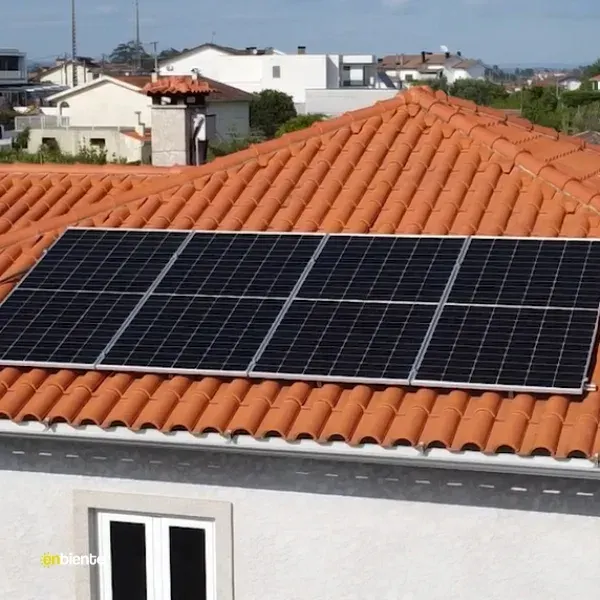
S. João de Lourosa - residential solar system with storage and full backup
Published on 9 June 2026
Residential photovoltaic system with 9 modules of 505 W, a Fronius GEN24 PLUS 4.0 hybrid inverter and a 6.3 kWh Fronius Reserva battery. A solution with full backup, Solar.web monitoring and expected self-consumption of 90% per year.
- Residential
- Solar
- Self-consumption
- Storage
- Backup
- Monitoring
Context
In a house in S. João de Lourosa, the owner was looking for a solution that went beyond immediate energy savings. The goal was to increase independence from the grid, improve the home’s sustainability and prepare the property for smarter energy management.
Daily consumption was stable, but full dependence on the grid limited autonomy and made energy management less predictable. The main requirement was to transform a conventional home into a space capable of producing, storing and managing its own energy, while maintaining comfort and safety even during grid failures.
Diagnosis
The project analysis identified four central needs:
- Local renewable generation, to reduce electricity purchased from the grid.
- Efficient storage, to make better use of solar energy produced during the day.
- Integrated backup, ensuring continuity of supply during blackouts.
- Digital monitoring, to track production, consumption, battery status and system performance.
Solution
Enbiente developed an integrated residential solution, highlighted by the installation of the first Fronius Reserva in Portugal.
The implemented solution included:
- 9 JA Solar Deep Blue 3.0 modules of 505 W, totalling approximately 4.545 kWp of installed photovoltaic capacity
- ESDEC Tiled Roof kit, suitable for integration on a pitched roof
- Fronius Primo GEN24 PLUS 4.0 hybrid inverter, designed to manage generation, consumption, storage and backup
- Fronius Reserva 6.3 kWh battery, scalable and designed for residential storage
- Fronius Smart Meter TS 100A-1, for energy metering and management
- Monitoring through the Solar.web platform
- Full backup in the event of a grid failure
The integration between solar generation, storage and control increases the use of locally produced energy and reduces dependence on the electricity grid.
Results
| Metric | Reported value |
|---|---|
| Installed photovoltaic capacity | 4.545 kWp |
| Number of modules | 9 |
| Power per module | 505 W |
| Battery capacity | 6.3 kWh |
| Expected self-consumption rate | 90%/year |
| Backup | Full backup during grid failure |
| Monitoring platform | Solar.web |
The original page does not provide annual savings, payback, real production data or measured historical consumption. For that reason, these indicators were not estimated in this case.
Operation
The installation enables monitoring of:
- Instantaneous and accumulated solar production
- Household consumption
- Battery state of charge
- Energy flows between panels, home, battery and grid
- Alerts and performance analysis through the Solar.web platform
The result is a more autonomous, efficient and future-ready home, where energy can be managed in a more predictable, digital and resilient way.